About the project
Vestiaire Collective is a premium resale marketplace for fashion - giving new life to pre-loved items through a trusted, authenticated buying and selling experience. Engaged and semi-pro sellers represent the backbone of the platform, with 10 to hundreds of active listings.
600 k
active sellers
🛍️
5 M
items listed
👗
30 k
listings posted per day
📲
66 %
engaged + semi-pro
🛒
This project was completed during The Design Crew bootcamp, from a brief presented by a Product Designer at Vestiaire Collective.
INITIAL CLIENT BRIEF
How might we help our engaged and semi-pro sellers manage their items and maximize their sales?
01 ———— Discovery
Seller journey audit & competitive benchmark
Since the initial brief was broad, I started by auditing Vestiaire's existing seller experience to understand what was already there before looking elsewhere.
Then I benchmarked 4 marketplace models: Vinted, eBay, Etsy and The RealReal - mapping how each platform supports sellers, from lightweight C2C flows to advanced dashboards and consignment models.
Vestiaire already guides sellers during listing creation, but once items are live, sellers still have to interpret scattered signals and decide what to do next.
Vinted keeps it simple. The RealReal removes the workload entirely. eBay and Etsy offer structured dashboards with advanced guidance.
For Vestiaire, the opportunity is specific: help sellers manage their listings more effectively - without removing control, and while respecting the trust and authentication standards of luxury resale.
Sellers are already guided
during listing creation


prompts to disclose item flaws
Sellers can see signals
once listings are live


But they seem to be left to interpret them on their own.
User research
The available research panel was composed of 4 active resale sellers using Vinted.
To avoid drawing invalid conclusions from a different context, I only retained behaviours that were transferable to Vestiaire: managing listings after publication, reading performance signals, deciding when to act, and balancing price, effort and visibility.
This was a deliberate methodological choice: narrow the research scope, focus on post-publication behaviours, and cross-check findings against Vestiaire's own product constraints.



Main hypotheses
☐ Volume creates mental load
☐ Sellers struggle to prioritize
☐ Price is sensitive
☐ They misread signals
☐ Visibility is central but opaque
🎙️ 45-min semi-structured interviews
Remote video calls



Ideation
After defining the challenge and success metrics, I moved into ideation to explore how Vestiaire could help sellers act on listing signals. I explored several directions:


Filtering the ideas
I used the constraints identified during the audit to narrow the solution space.
The goal was not to bypass Vestiaire’s constraints, but to design within them: price drops are final, some listing changes may require review, live listings have limited editability, and I did not have access to the full backend or operational logic.
This led me to filter ideas through 3 criteria:
🛠️
Feasibility
What could be designed realistically without assuming unknown backend logic
💪
Seller control
what would preserve control over sensitive actions such as price drops or listing edits
🚧
Vestiaire's boundaries
What would respect the constraints revealed by the audit
3 main design trade-offs

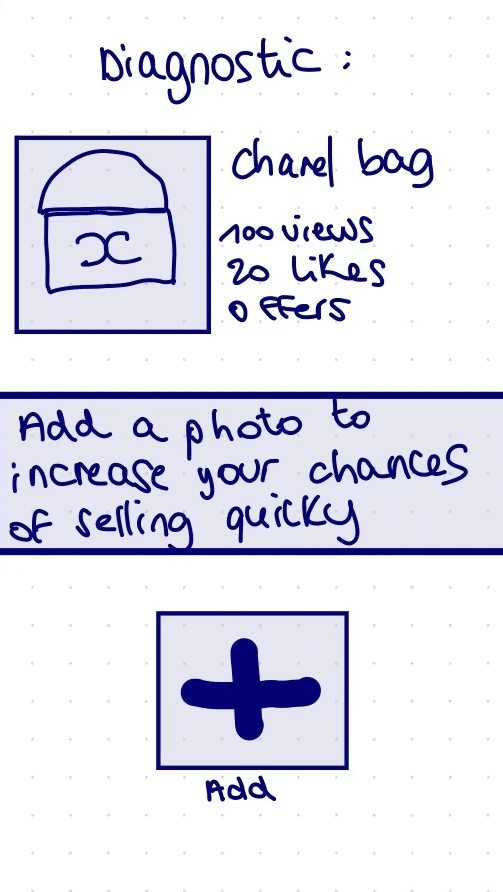


Pattern inspirations
Before sketching solutions, I looked at interaction patterns from other products to understand how they help users prioritize, act or avoid mistakes.
The goal was to identify useful mechanics that could be adapted to Vestiaire’s seller context.
Etsy: Today's top tasks

Todoist: Prioritization

Airbnb: Warnings before final actions

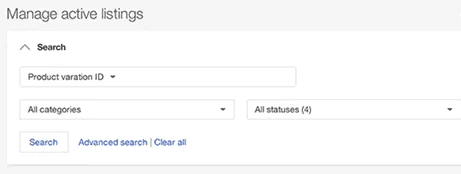
eBay: Seller hub filters

Duolingo: Feedback

Solution
The selected direction was Needs attention: a lightweight recommendation layer inside the existing Listings experience.
Instead of asking sellers to scan their catalogue manually, the feature surfaces listings that may need action, explains why, and connects each diagnosis to an existing seller lever.
04 ———— V1
Designing a testable prototype
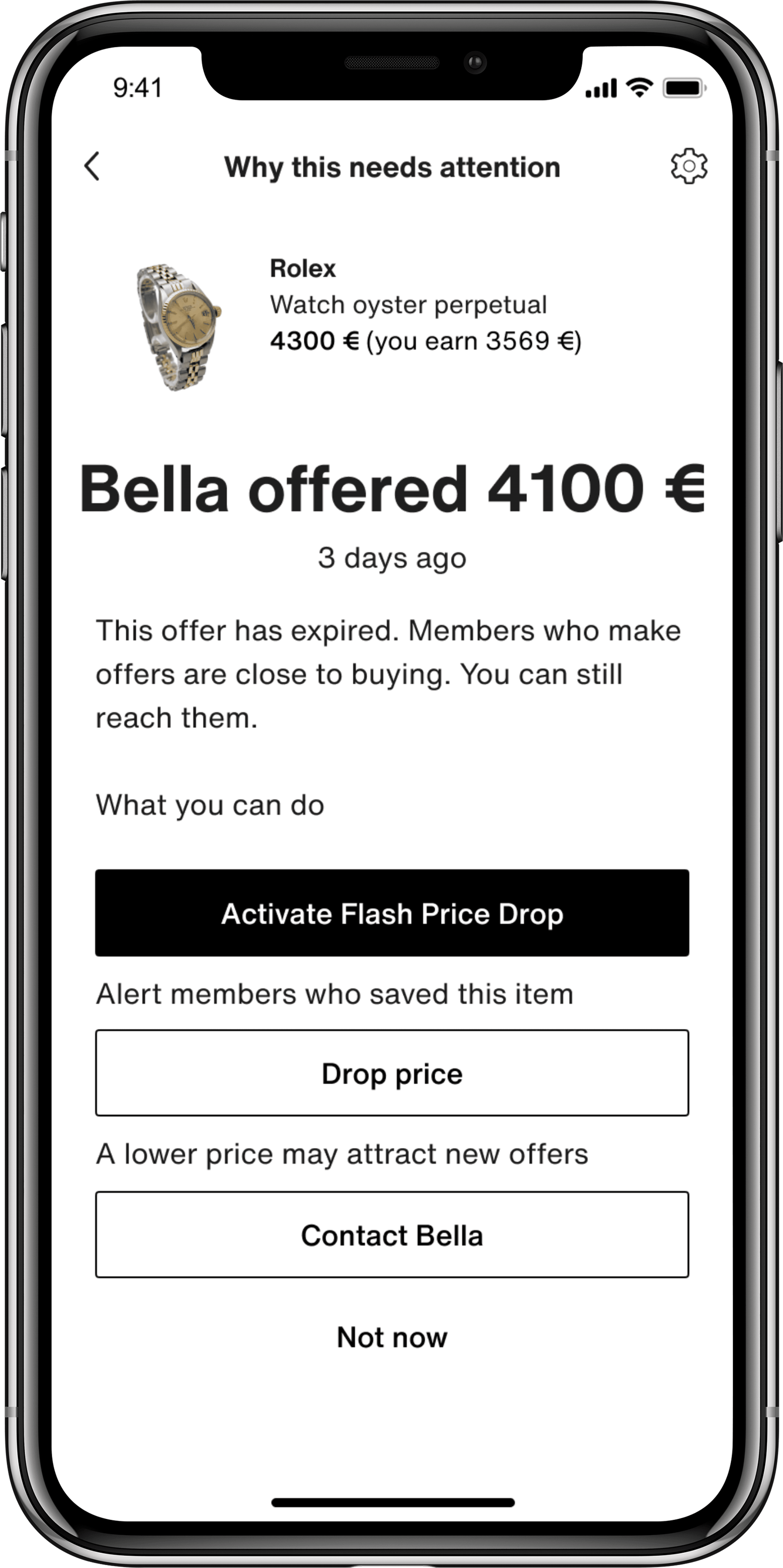
I translated the Needs attention concept into a high-fidelity mobile prototype.
Each screen was designed as a concrete seller step, from identifying the issue to tracking the result.
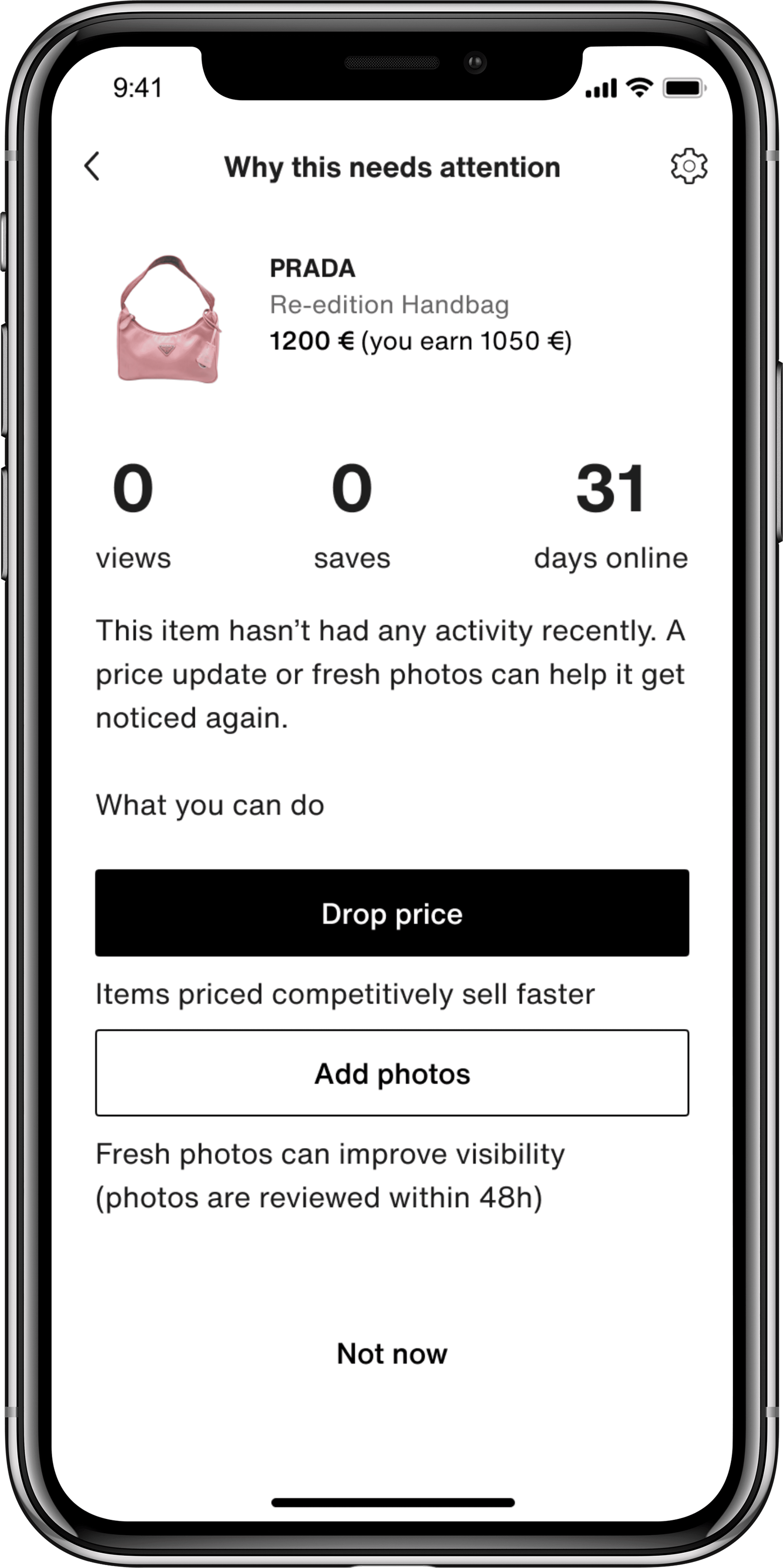
The screens below show one full V1 flow and two condensed diagnostic flows.
DIAGNOSTIC #1
Low saves
Item viewed often but rarely saved


DIAGNOSTIC #2
No activity
No recent views or saves





06 ———— V2
Iterating the experience
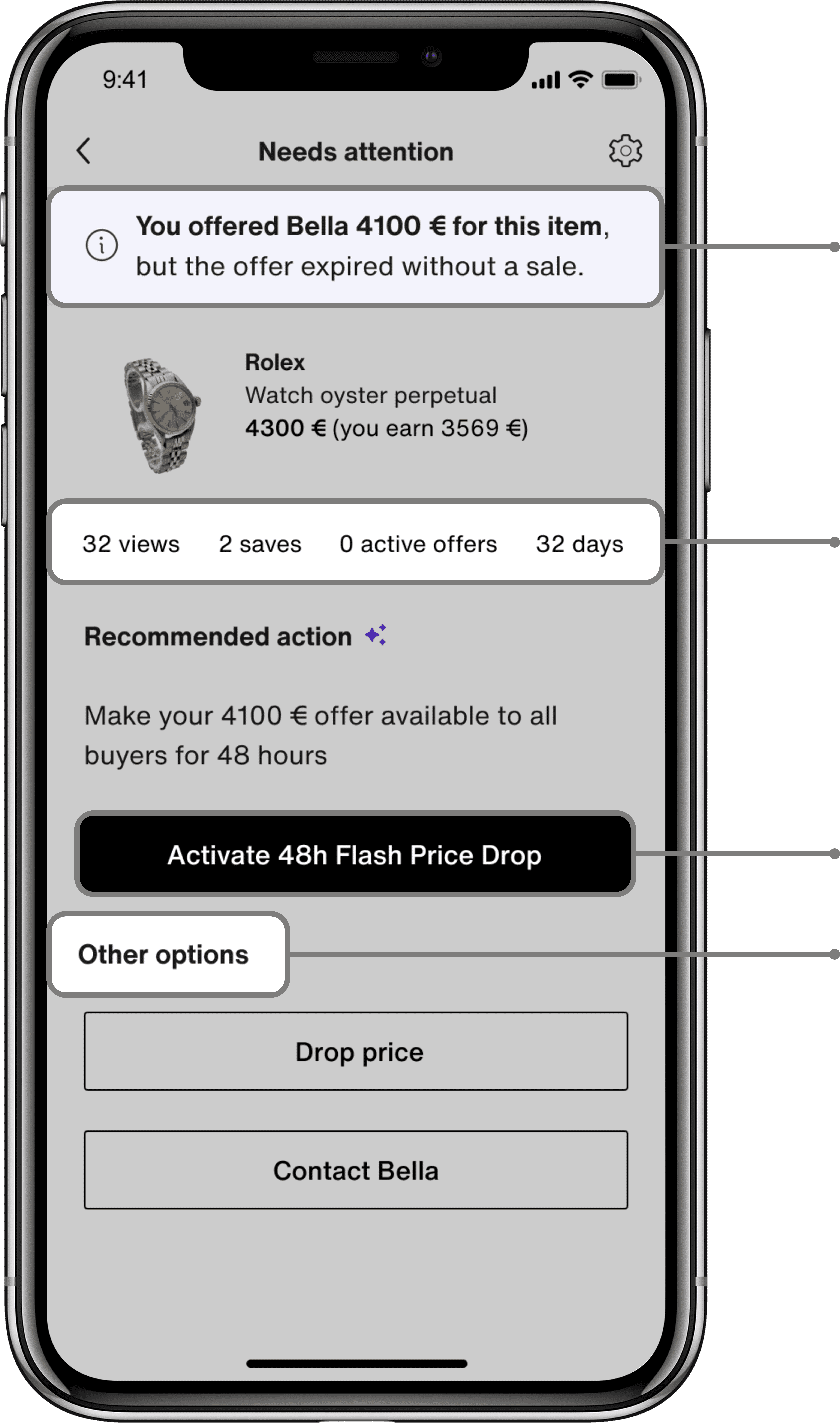
Based on user testing, I focused the V2 iteration on clarity, action hierarchy and scalability.





08 ———— Success metrics
KPIs
As the feature was not shipped, these KPIs define how I would evaluate whether the recommendation layer helps sellers act on listing signals and improves sales performance.
09 ———— Going further
Next opportunities
The V2 prototype focused on helping sellers act on priority listings. These next opportunities would make the system more scalable, contextual and flexible for larger seller catalogues.
📈
Add stronger market context
Show average time to sell, recent similar sold items and price ranges to help sellers judge whether an action is relevant.
🔓
Controlled bulk actions
Let sellers add or remove multiple listings at once, and review grouped price updates with final confirmation for each price drop.
⏰
Let sellers snooze recommendations
Allow sellers to hide or postpone recommendations they do not want to act on immediately.
Reflection
AUTOMATION ISN'T ENOUGH
Reducing cognitive load wasn't only about automating tasks. It also meant reducing decisions and directing attention to what actually required user input.
VISIBILITY NEEDS STRUCTURE
Making more information visible doesn't necessarily make a process clearer. Hierarchy and progressive disclosure became essential as the experience grew.
DESIGN BEYOND THE HAPPY PATH
Designing for errors, uncertainty and required actions proved as important as designing the ideal submission flow.